
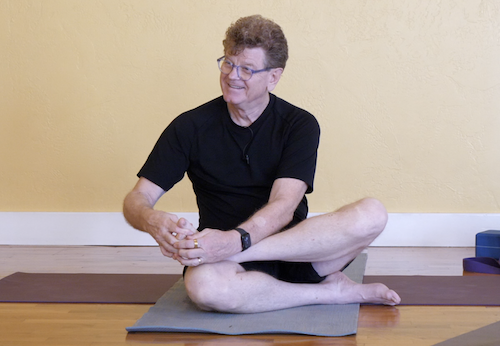
A course with Doug Keller
Starts Fri 14 Aug
Studio
Doug Keller shares a framework for understanding your body that changes how you practice.
For teachers and trainees.
Fri 14th Aug 2026 ~ 6pm to 9pm (3hrs)
Sat 15th Aug 2026 ~ 9:30am to 5pm (7½hrs)
Sun 16th Aug 2026 ~ 9:30am to 5pm (7½hrs)
- £275 -
You can pay by instalments if it's easier - £139 deposit + 2 payments of £68.
Friday Evening
Dynamic Alignment: ‘Alignment’ from the Perspective of Movement, From the Feet Upward.
In this session we’ll introduce a dynamic, fascia-based approach to the therapeutic wisdom of yoga, we’ll lay out basic principles to addressing joint and fascial pain syndromes through the prism of the feet.
Joints and muscles are for movement. Traditional approaches to ‘grounding’ the feet in yoga poses tend to be static, and fall short of addressing the pain syndromes that arise in the feet and ankles — as well as problems in the knees and hips — from movement patterns that can be improved through asana practice.
A more dynamic understanding of how the feet work in movement — including in asana practice — will put a bounce back in your step and give you clues for addressing the most common pain syndromes that arise in the lower body through simple and sweet asana practice.
Saturday Morning
Resistance Is Not Futile: Maintaining Upper Body Strength and Shoulder Health
Props have always been a part of yoga practice, but they have always been used as support for when flexibility is lacking, or for relaxation. But a key issue, particularly with aging, is maintaining upper body strength, which is essential for shoulder health. Our use of props should serve to help us with this too, and without risk of injury.
In this session, we’ll make use of resistance bands, pairing them with poses — both standing poses and floor poses — to practice shoulder and core actions that will not only enhance the strength of the muscles controlling shoulder movement, but will increase range of motion and help reduce shoulder pain.
This approach will give us a lens through which to understand shoulder movement more deeply, and improve the coordination between muscles that keep the shoulders moving freely and with less pain and restriction. The work will be clear, accessible, and precise, and notes from the session will help you remember what we’ve covered.
The work won’t be limited to the resistance bands, and we’ll progress to a wider range of poses, including backbending, to see how the work with the bands has helped.
Saturday Afternoon
The Power of Mudra — Supporting Your Breath and Meditation Practice
‘Mudra’ was, from the beginnings of hatha yoga, central to the practice, and encompassed not just hand gestures, but asana, bandha, drishthi (the gaze of the eyes), and even states of meditation. It is a central support for all aspects of yoga practice, and an essential tool for your yoga.
In this session, we will focus on fundamental mudras of the hands, and their direct connection to your experience of the breath. You’ll find this to be a surprisingly tangible support for your breath practice, and we’ll explore the link between both the ‘Vayus’ of Prana and mudra in fundamental pranayama practices for calming your nervous system and clarifying your mind, and the role of Mudra in connection with the ‘elements’ in Ayurveda for balancing the doshas — and guiding you into deep relaxation or ‘Yoga Nidra.’
Sunday Morning
Balance Is Equanimity: At Play in the Field of Gravity
It is pretty much universally the case that balance becomes more challenging with age, for quite a few reasons. Nevertheless, there are aspects of our ability to balance that can be improved through our practice, in terms of hip strength as well as attention to our foundation in our feet and dynamic alignment of our knees.
In this session we’ll make use of resistance bands as part of a program for increasing hip strength (the abductors in particular, which are key to balance) and range of motion. And we will work with our foundation for balance in the feet, and their connection to the knees. Moreover, we’ll incorporate work from Saturday, to connect upper and lower body through our core to explore healthy functional movement in asana.
The practice will include some supported balancing poses, such as Tree Pose and variations on it for improving balance, as well as standing poses and floor exercises.
But the practice will by no means be limited to just balancing poses: the deeper theme is to experience balance and equanimity in movement, at play in the field of gravity.
And balance is not just about the legs! In the floor poses we’ll pay attention to the foundation of the sit bones, and their relationship to the health of your low back, and experience of equanimity in seated breathing practices.
The overall practice will be well-rounded, going beyond the use of resistance bands to see what the work with them has taught us!
Sunday Afternoon
Mudra Part 2: The Power of Drishthi, and Equanimity in the Breath
There is an intimate connection between the actions of your eyes and your experience of the breath, particularly in nostril breathing, as well as your ability to focus your mind in meditation as well as in daily life. The eyes are in fact key to ‘cleansing’ and balancing your ‘nadis’ in ‘Nadi Shodhana’ — and we’ll explore exactly what that means in very practical and therapeutic terms!
In this session we’ll explore the particulars of breathing through your nose in pranayama — practices for addressing the ‘how’s’ of breathing through the nose when you experience obstacles to doing so, as well as explorations of the ‘why.’ Breathing through your nose is vitally supportive to your health, and fundamental practices of pranayama are meant to help you with this.
And the action of your eyes — your gaze or drishthi — is fundamentally connected to opening the ‘nadis’ of your nostrils. We’ll explore basic forms of drishthi for both breath and meditation, and how this often neglected awareness is incredibly supportive of your equanimity, both in your meditation practice and in your everyday life and its challenges. Drishthi is a fundamental part of ‘mudra,’ and a powerful practice for rebooting your brain and breath — and not just when you roll your eyes at the absurdities of life!
** PRACTICAL BITS **
Due to the nature of the Crescent Bakery building, it's ideal to wear layers of clothing for cooler / warmer fluctuations.
If you're looking for somewhere to stay near the studio, click here for info.
Please note workshops will be refunded only if we can find someone to take your place. Obviously, we will take account of exceptional circumstances. If you have chosen to pay in instalments, payments to completion will still be due.
Please contact studio@orangeyoga.co.uk and we’ll be happy to help.